Crow or raven? How to tell them apart
They are cousins, and from a distance they look alike. Size helps a little. The tail, the voice and the bill tell you for sure.
The quick test
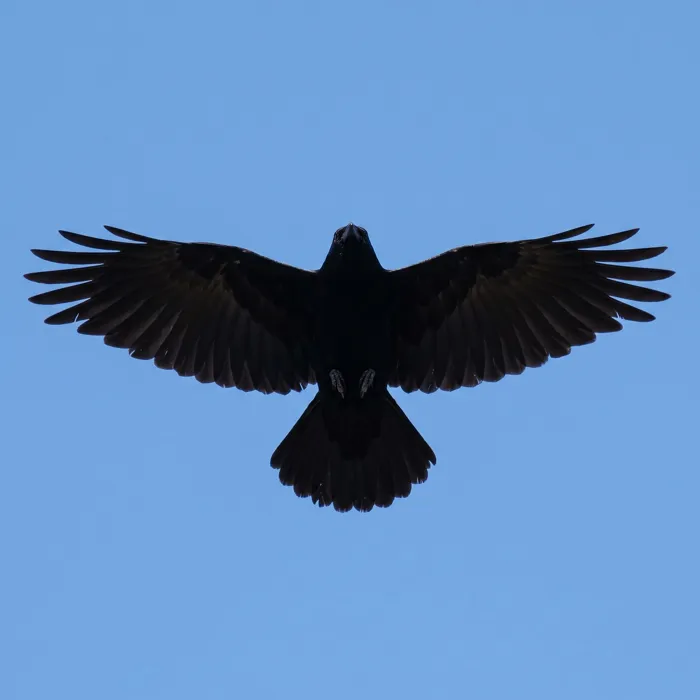
Watch it fly overhead. A fan-shaped tail means crow. A wedge, like a diamond tip, means raven. If it is making noise, a clear "caw" is a crow and a deep rolling croak is a raven. Those two marks settle almost every sighting.
- CrowPigeon to small-hawk size. Fan-shaped tail, squared off. A clear "caw, caw" in bouts of two to five. Slimmer, straighter bill and a smooth throat. Family groups and big winter roosts. Flaps steadily, rarely soars.
- RavenRed-tailed-hawk size, 22 to 27 inches long with a wingspan around four feet. Wedge-shaped tail, pointed in the middle. A deep croak, "gronk," plus knocks and bell-like notes. Heavy curved bill and shaggy throat feathers. Often in pairs, loves to soar.
Tail shape: the mark that works at any distance
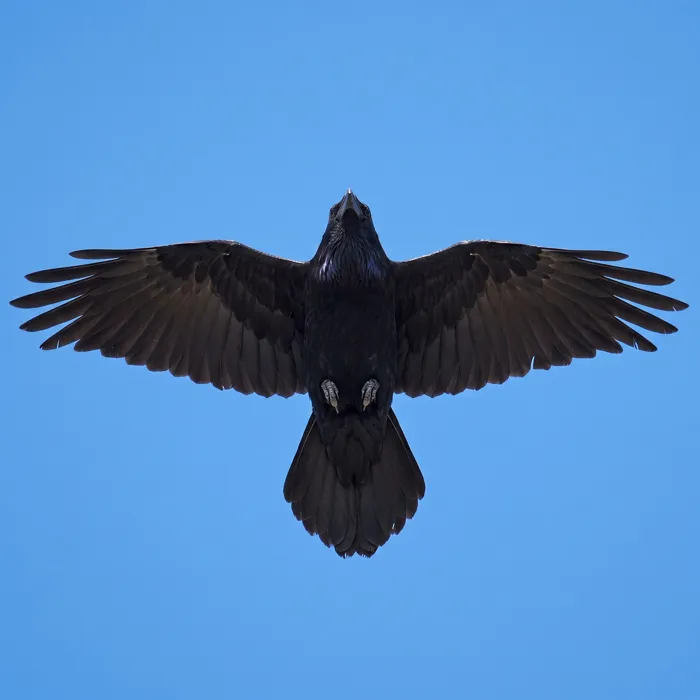
In flight, a crow's tail spreads into a fan with a squared-off end. A raven's tail is longer and tapers to a point in the middle, a wedge shape that is obvious from below even when the bird is high up. This is the mark birders rely on, because it does not depend on judging size against nothing.
The call: caw versus croak
American crows give the classic "caw," usually in bouts of two to five, along with rattles, clicks and soft coos between family members. Ravens croak. The sound is deeper and rougher, often written as "gronk," and ravens also make knocking sounds, screams and oddly musical bell-like notes. If you hear a croak, you are almost certainly looking at a raven.
Size: helpful, but only with something to compare
An American crow is 16 to 21 inches long with a wingspan of 33 to 39 inches. A common raven is hawk sized, 22 to 27 inches long with a wingspan around four feet. Side by side the difference is obvious. Alone on a wire, size is a guess, which is why the tail and the voice come first.
Bill and throat
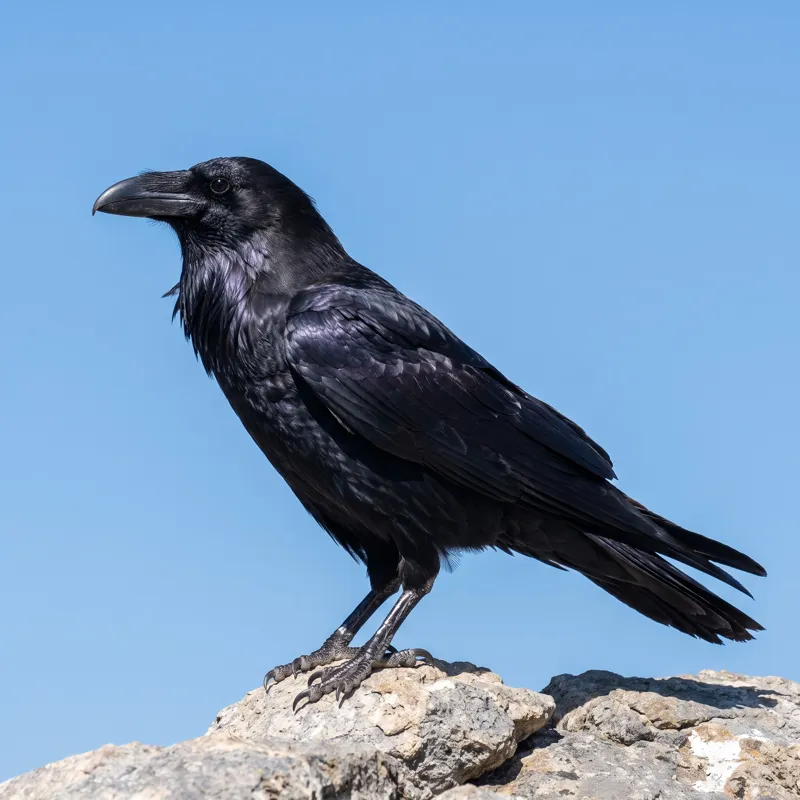
A crow's bill is slimmer and straighter, and its throat is smooth. A raven's bill is heavy and curved, with long bristles at the base, and the throat feathers are shaggy, like a beard, especially when the bird is calling. Through binoculars, the beard alone can settle it.
How they move and who they are with
Crows flap steadily and rarely soar. They move in family groups, gather in noisy flocks on lawns, and in fall and winter fly off at dusk to sleep in big communal roosts, sometimes miles away. Ravens love to soar and tumble on thermals, and are more often seen in pairs than in crowds. A big black bird gliding in slow circles with its wings flat is more likely a raven; one flapping across a parking lot to join six others is a crow.
The fish crow
Along the southeast and Gulf coasts of the United States there is a third option. The fish crow is nearly identical to an American crow, a little smaller and slimmer, and the only reliable field mark is the voice: a nasal "uh-uh" or "cah," often doubled, instead of a clear caw. It hunches and fluffs its throat when calling, and it stays near water.
Black birds that are not crows at all
Several black birds get mistaken for crows. One mark settles each.
- Common grackle11 to 13 inches, noticeably smaller than a crow. Bright yellow eye and a long tail it often holds in a keel shape. Crows have dark eyes.
- Great-tailed grackleCommon in Texas, the Southwest and California, often in parking lots. A huge V-shaped tail and a yellow eye. Loud whistles and clacks, never a caw.
- Brewer's blackbirdRobin sized with a pale yellow eye. Common in the West, walking on lawns.
- European starlingSmaller than a robin, with a short square tail and pointed triangle wings in flight. Speckled in fall and winter. Noisy flocks.
- Black vultureRaven sized with far wider wings. Bare gray head and silvery white wingtips when soaring. The big black bird circling overhead.
Once you know which bird you have, the next step is the same either way: a spot, a time and a handful of peanuts.
Questions people ask
Crow or raven: what is the difference?
Ravens are larger, about hawk sized, with a wedge-shaped tail, a heavier bill and shaggy throat feathers. They croak and often travel in pairs. Crows are smaller, have a fan-shaped tail, caw, and usually move in family groups.
Are crows and ravens the same?
No. They are close cousins in the same family, the corvids, but they are different species. The American crow and the common raven differ in size, tail shape, voice, bill and behavior.
Are ravens bigger than crows?
Yes. A common raven is 22 to 27 inches long with a wingspan around four feet, about the size of a red-tailed hawk. An American crow is 16 to 21 inches long with a wingspan of 33 to 39 inches.
Are crows smarter than ravens?
Both are among the most intelligent birds studied, and researchers have documented tool use, problem solving and long memory in each. There is no agreed ranking between the two, and most of the famous studies on remembering human faces were done with crows.
Do crows and ravens get along?
Not especially. Crows often mob ravens, usually in groups, the way they mob hawks and owls. Where both live, you will see crows chasing a raven more often than the two sharing a tree.
Crow Friends remembers every step.
The app walks you through the routine, keeps your feeding streak, lets you name each crow, and logs the day a crow first stayed, first waited for you, or first left you something. It is not in the App Store or Google Play yet. Join the waitlist and we will email you the day it is out.
Join the waitlist